CORAL
The CORAL corpus was collected in the framework of a national
project sponsored by the PRAXIS XXI program, by a consortium formed by
INESC, CLUL, FLUL (Faculdade de Letras da Universidade de Lisboa), and
FCSH-UNL (Faculdade de Ci�ncias Sociais e Humanas da Universidade Nova
de Lisboa). The purpose of this project is the collection of a spoken dialogue
corpus, with several levels of labelling: orthographic, phonetic,
phonological, syntactic and semantic.
- Linguistic contents
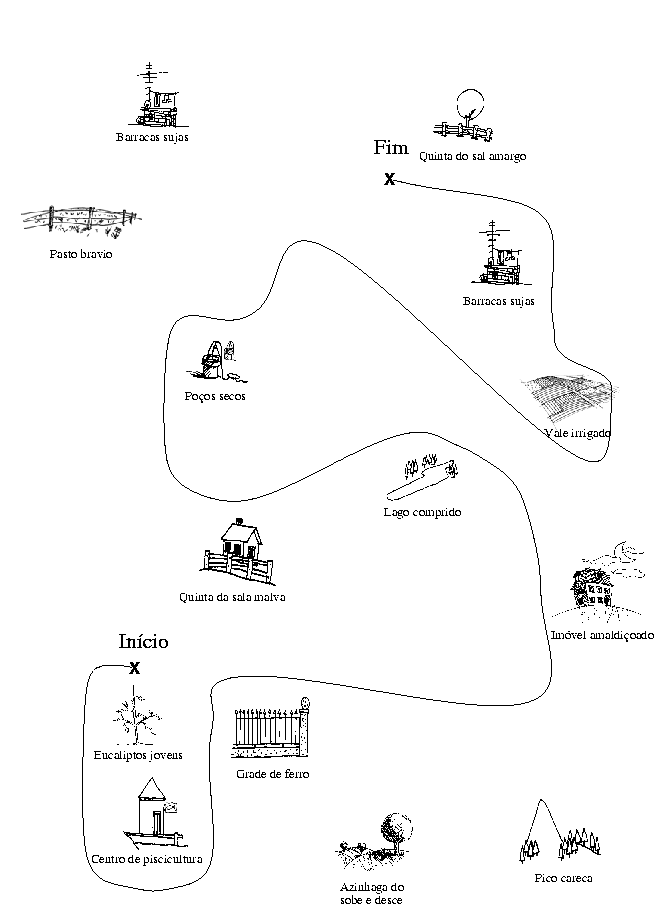
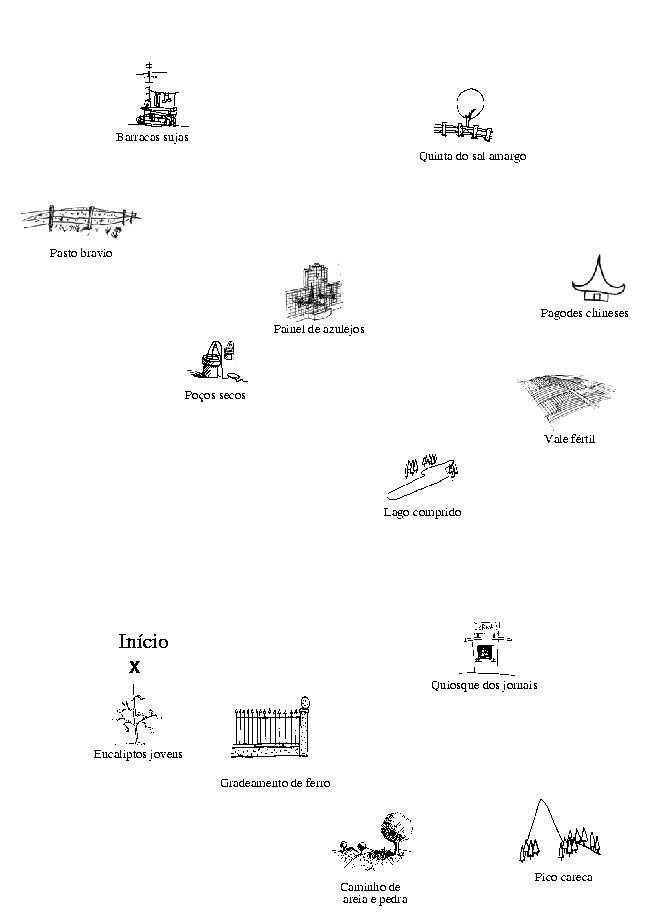
64 dialogues about a predetermined subject: maps. One of the
participants (giver) has a map with some
landmarks and a route drawn between them; the other (follower) has also landmarks, but no
route and consequently must reconstruct it. In order to elicit conversation,
there are small differences between the two maps: one of the landmarks
is duplicated in one map and single in the other; some landmarks are
only present in one of the maps; and some have slightly different
names in the two maps (e.g. curvas perigosas vs. tro�o
sinuoso ).
In the 16 different maps, the names of the landmarks were chosen to allow
the study of some connected speech phenomena:
- sequences with /l/ favouring or not its velarization
(e.g. sala malva, sal amargo)
- Sequences with /s/ in word final position followed by another coronal
fricative (e.g. barcos salva-vidas)
- Sequences of plosives formed across word boundaries (e.g.
clube de tiro)
- Sequences of obstruents formed within and across word boundaries
(e.g. bairros degradados)
The last three items were designed to allow a more comprehensive study
of consonant clusters formed within and across word boundaries and
should, therefore, be jointly investigated.
- Number and type of speakers
The 32 speakers were divided into 8 quartets
and, in each quartet, organized to take part in 8 dialogues.
Given the reduced number of speakers, they were chosen to achieve an
adequate balance of sexes, but were restricted in terms of age
(under-graduate or graduate students) and accent (Lisbon area).
Speakers are chosen in pairs who know each other, so that half of the
conversations take place between ``friends'' and half between people
who do not know each other.
- Data collection
The recordings take place in a sound proof room, with no visual
contact between the speakers. They wear close-talking microphones and
the recordings are made in stereo directly to DAT and later
down-sampled to 16 kHz per channel. No monitoring is done once the
dialogues start, after adjusting recording levels. The recording phase
is not yet complete.
- Annotation
A subset of the corpus will be annotated in several levels. Only orthographic transcription will be done for
the whole corpus.